Holotropic Breathwork (moving towards wholeness)
ARTICLE EN ANGLAIS

ARTICLE EN ANGLAIS
Holotropic Breathwork® was developed by psychiatrist Stanislav Grof, M.D., one of the pioneers of research into non-ordinary states of consciousness, together with Christina Grof.
Born in Prague, Stanislav Grof began his psychiatric career in the 1950s and became one of the early researchers investigating the therapeutic potential of psychedelic substances, particularly LSD, in carefully controlled clinical settings. After moving to the United States in 1967, he continued his research and developed an extensive body of work on the nature of consciousness and the human psyche.
When psychedelic research became increasingly restricted, Stanislav and Christina Grof developed Holotropic Breathwork as a non-pharmacological approach to accessing expanded states of consciousness.
I trained in California with Dr Stanislav Grof and completed the Grof Transpersonal Training programme in Holotropic Breathwork and transpersonal psychology. This training became an important part of my own development as a clinician and profoundly influenced the way I understand the relationships between the unconscious, the body and non-ordinary states of consciousness.
My approach is rooted in about forty two years of clinical experience as a psychologist, psychoanalyst and psychotherapist. Over the years, I have built bridges between psychoanalysis, body-oriented approaches and transpersonal psychology, which I see not as competing models but as different ways of approaching the complexity of the human psyche.
The word holotropic comes from the Greek holos, meaning “whole”, and trepein, meaning “moving toward”. It can therefore be understood as “moving toward wholeness”.
Holotropic Breathwork combines several elements: deeper and accelerated breathing, evocative music, focused bodywork when appropriate, artistic expression and verbal integration.
The purpose is not to impose a particular experience or interpretation. Rather, the participant is invited to turn inward and allow whatever needs to emerge to unfold in its own way.
One of the central principles of Grof’s approach is what he describes as the inner healing intelligence: the idea that, in an appropriately held non-ordinary state of consciousness, the psyche may spontaneously bring forward material that is emotionally significant for the individual.
The facilitator therefore does not direct the experience according to a predetermined psychological theory. My role is primarily to provide a safe therapeutic framework, remain attentive to the process, intervene when necessary and subsequently help the person integrate what has emerged.
A Holotropic Breathwork session usually begins with relaxation and an invitation to deepen and accelerate the breathing.
There is no specific experience that participants are expected to have. A session may involve bodily sensations, emotions, memories, symbolic imagery, movements, sounds or periods of profound stillness.
For some people, the experience may remain largely physical or emotional. Others may encounter autobiographical memories or powerful symbolic material. Some report experiences they describe as spiritual, archetypal, mystical or transpersonal.
These experiences are welcomed without requiring a particular belief system.
The aim is neither to suggest what an experience “really” means nor to impose a spiritual interpretation upon it. What matters therapeutically is how the person experiences it, what meaning it may acquire for them, and how it can subsequently be integrated into their life.
Music plays an essential part in Holotropic Breathwork.
It accompanies and supports the process without determining it. The musical sequence generally begins with activating and rhythmically powerful pieces, gradually moves towards more intense or evocative music, and later becomes quieter, more spacious and meditative.
Music can facilitate access to emotions and memories that may be difficult to reach through ordinary verbal processes. It can also provide a continuous thread through periods of intensity.
I carefully adapt the musical journey to the atmosphere and energy of each group.
In group workshops, participants usually work in pairs. One person is the breather, while the other is the sitter. They later exchange roles.
The sitter’s role is essential. He or she remains present and attentive without directing, interpreting or unnecessarily interfering with the breather’s experience.
Before the session begins, clear boundaries are established, particularly concerning physical contact and the kind of support the breather may or may not want.
Safety and respect for personal boundaries are fundamental.
The breather is free to move, make sounds, cry, laugh or remain completely still, provided that neither the participant nor anyone else is put at risk.
From decades of work with psychedelic therapy and subsequently Holotropic Breathwork, Stanislav Grof proposed an expanded cartography of the human psyche.
In addition to the biographical unconscious familiar to traditional psychotherapy, he described two further domains: the perinatal and the transpersonal.
This map should never be regarded as a programme that participants are expected to follow. It is a theoretical framework developed by Grof from his clinical observations.
At the biographical level, memories and emotions connected with a person’s life history may emerge.
These can include childhood experiences, relationships, loss, separation, accidents, medical procedures or traumatic events.
Unlike a purely verbal approach, Holotropic Breathwork may allow these experiences to emerge simultaneously through emotions, bodily sensations, images, movements and memories.
The emphasis is not necessarily on analysing the experience while it is happening, but on allowing it to unfold and subsequently finding ways to integrate it.
Grof observed that some experiences arising in non-ordinary states appeared to contain themes associated with birth: enclosure, pressure, struggle, suffocation, passage, separation, release or rebirth.
He organised these observations into what he called the Birth Perinatal Matrices (BPMs).
The four matrices correspond symbolically to different phases of the birth process, from intrauterine existence through contractions and passage through the birth canal to separation from the mother’s body.
Grof proposed that these patterns could sometimes become associated with later emotional and symbolic themes.
This remains a distinctive element of Grof’s theoretical model rather than an established account of psychological development, and I approach such material phenomenologically: what matters first is what the person actually experiences and the meaning it acquires for them.
Some participants describe experiences that seem to extend beyond their ordinary sense of personal identity.
They may include feelings of unity, encounters with powerful archetypal figures, identification with nature or animals, shamanic imagery, religious or mystical experiences, or experiences that the participant may interpret as belonging to another time or another life.
Such experiences can be extraordinarily vivid.
As a therapist, I do not determine whether they should be understood literally, spiritually, symbolically or psychologically.
My responsibility is to respect the experience without imposing an ideology upon it and to help the person explore what it means within the context of their own psychic life.
This distinction is essential to my work.
An unusual state of consciousness is not in itself evidence of pathology. At the same time, not every unusual experience should automatically be interpreted as spiritual or transformative. Clinical discernment remains essential, particularly when a person is psychologically vulnerable or when the capacity to return to ordinary functioning is compromised.
Sometimes the breathing process and spontaneous movements lead naturally to a feeling of completion. At other times, tension or discomfort remains in the body.
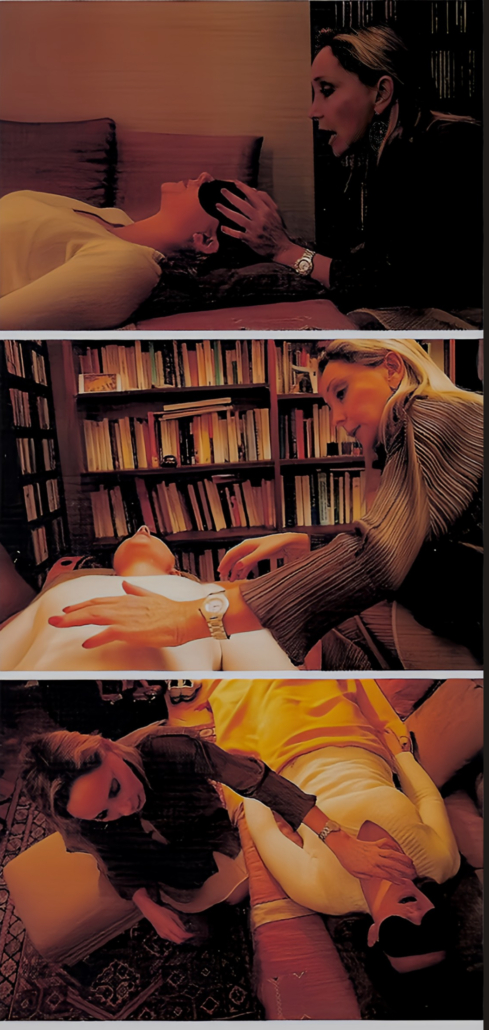
When appropriate, and always within clearly established boundaries and with the participant’s consent, focused bodywork may be used to help the person explore and release remaining tension.
The participant remains in control throughout the process and can ask for any intervention to stop.
The end of the breathing session is not the end of the therapeutic process.
Afterwards, participants are invited to draw or paint a mandala representing something of what they have experienced.
No artistic ability is required. The purpose is not to create an aesthetically successful image, but to give form to an experience that may not yet be fully accessible through words.
This transition from inner experience to image can be an important first step towards integration.
Participants later have an opportunity to share their experience with the group. Sharing is encouraged but never compulsory.
The facilitator’s role is not to provide an authoritative interpretation of the mandala or the experience. The aim is to help the participant find their own language and meaning.
Although Holotropic Breathwork is a contemporary therapeutic method, deliberately induced non-ordinary states of consciousness have existed in human cultures for thousands of years.
Meditation, prayer, chanting, rhythmic drumming, dancing, fasting and different forms of breath practice have all been used in spiritual, initiatory and healing traditions.
Shamanic cultures have also used rhythm, movement, ritual and altered states of consciousness as part of their practices.
Holotropic Breathwork does not attempt to reproduce these traditions. Rather, Grof’s work places the modern exploration of consciousness within a much longer human history of deliberately entering states that differ from ordinary waking consciousness.
My original training is in clinical psychology and psychoanalysis, and I have been practising as a clinician for about forty years.
Over the years, my clinical practice has also incorporated EMDR, Ericksonian hypnosis, body-oriented approaches, creative processes and transpersonal psychology.
My training in the United States with Stanislav Grof was a major step in this journey. Holotropic Breathwork opened for me a dimension of therapeutic work in which the body, unconscious imagery, emotion and symbolic experience can emerge together.
I do not see these approaches as replacing psychoanalysis or psychotherapy.
They offer another doorway.
For some people, words are the privileged path towards the unconscious. For others, there are moments when the body, breath, image or movement can reach material that words alone have not yet been able to approach.
The essential work then lies in integration: bringing the experience back into one’s psychological and everyday life rather than remaining fascinated by the altered state itself.
Holotropic Breathwork can be physically and emotionally intense and is not suitable for everyone.
Participation therefore requires prior screening.
Particular caution or contraindications may apply in the case of cardiovascular conditions, uncontrolled high blood pressure, pregnancy, epilepsy or seizure disorders, glaucoma or retinal problems, recent surgery or significant physical injury, and certain severe psychiatric conditions.
This list is not exhaustive.
Before participating in a workshop or individual session, I speak with each new participant in order to assess whether this approach is appropriate for them. When there is any medical uncertainty, medical advice may be required beforehand.
Holotropic Breathwork should be practised within an appropriately trained and carefully supervised setting. It is not a breathing exercise that I recommend undertaking alone.
Non-ordinary states of consciousness can sometimes be profound, but intensity alone is not therapeutic.
What matters is what becomes possible afterwards: understanding, integration, psychological movement and, sometimes, a different relationship with oneself.
For this reason, I regard Holotropic Breathwork not as an isolated technique, but as one element within a broader psychotherapeutic process.
It can create a passage between the spoken and the unspoken, between psychological history and bodily experience, and between the familiar dimensions of the self and those parts of our inner life that remain more difficult to name.
Martine Gercault is a clinical psychologist, psychoanalyst and psychotherapist with about forty two years of clinical experience.
Her approach brings together psychoanalysis, psychotherapy, body-oriented approaches and transpersonal psychology. She has also trained in EMDR and hypnosis and completed the Grof Transpersonal Training programme in the United States with Dr Stanislav Grof, with whom she trained in Holotropic Breathwork and transpersonal psychology.
She has facilitated Holotropic Breathwork groups for nearly 36 years and has developed an integrative clinical approach in which non-ordinary states of consciousness are approached with both openness and psychological discernment.
Her work explores the bridges between the unconscious, the body, creativity and expanded states of consciousness.
Numéro RPPS 10008874603
Membre individuel de la FF2P
(Fédération Française de Psychothérapie et Psychanalyse)
11, boulevard Delessert
75016 Paris
Tél : 01 45 20 77 27
Port : 06 30 60 24 38
mgercault@gmail.com

Pour prendre rendez-vous en ligne cliquez sur l’image


Psychologue Clinicienne, Psychanalyste-Psychothérapeute
Numéro RPPS 10008874603 | Membre individuel de la FF2P (Fédération Française de Psychothérapie et Psychanalyse)
 11, boulevard Delessert | 75016 Paris
 01 45 20 77 27 | 06 30 60 24 38
 Sur rendez-vous en cabinet ou en visio


 L’art-thérapie et le Pinceau Chamane®